
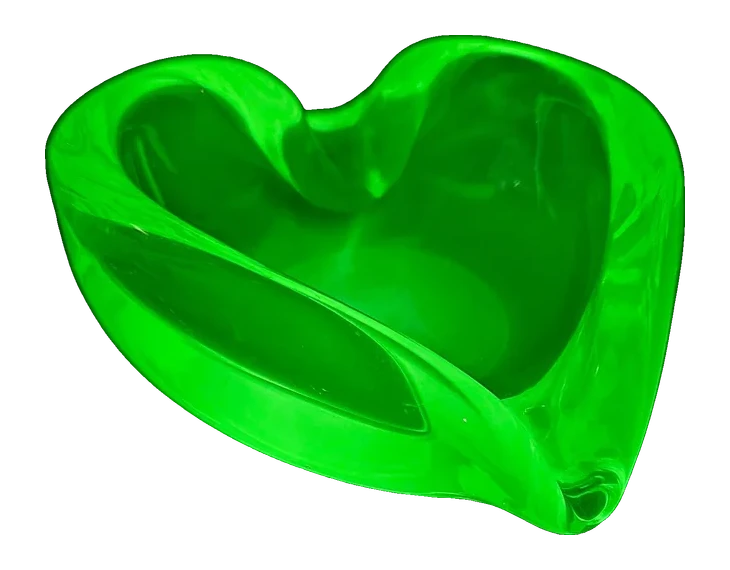
What is uranium glass?
Uranium glass is glass with a small amount of uranium added to the batch as a colorant. In daylight it ranges from pale yellow to green. Under ultraviolet light it fluoresces a strong, bright green.
Glassmakers in Europe were using it by the 1830s, and it stayed popular through the Victorian era and into the Depression years. In the US, production stopped during World War II when the government took control of uranium supplies, and it didn't really come back until restrictions eased in the late 1950s. Fenton, for one, was making uranium-bearing glass again by 1959.
Vaseline, custard, Depression glass and more
"Vaseline glass" is what collectors call the transparent yellow-green kind, named for its resemblance to old-fashioned petroleum jelly. Opaque yellow "custard" glass, some green Depression glass, and a lot of opalescent and pressed pieces can contain uranium too.
Color alone isn't proof. Plenty of green and yellow glass has no uranium in it at all, and some uranium glass is a color you wouldn't expect. That's why the UV test matters.
How to identify uranium glass
Any UV flashlight will show it: uranium glass glows a strong, even green from inside the glass. Other glass can glow too, usually weaker or in other colors: manganese a faint greenish-yellow, lead an icy blue, some selenium and cadmium glass orange or red. A 365nm flashlight shows those other glows more clearly than a 395nm one, whose visible purple light can tint pale glass, so experienced collectors use it to tell glass types apart. Either way, we go by the color and strength of the glow, not just whether there is one.
One catch: a green glow tells you there's uranium, not how old the piece is. Some uranium glass is still made today, so we also look at mold seams, wear, pattern and maker. We test every piece on camera during our shows so you can see the glow for yourself before you bid.
Is uranium glass valuable?
Some of it is, a lot of it is affordable, and the glow alone doesn't make a piece rare. Maker, pattern, color, size and condition do the heavy lifting. A chipped common sherbet glows just as bright as a perfect early piece, but they don't sell for the same money. Recent sold listings are a better guide than any price chart.
Uranium Glass FAQ
How can I tell if glass is uranium glass?
Shine a UV flashlight on it in a dark room. Uranium glass glows a strong, even green from inside the glass. Other glass can glow too, usually weaker or in other colors, and daylight color isn't a reliable test.
What's the difference between uranium glass and Vaseline glass?
Vaseline glass is one type of uranium glass: the transparent yellow-green kind. Uranium glass is the bigger family, which also includes opaque custard glass, some green Depression glass and other colors.
Can you identify uranium glass without a blacklight?
Not reliably. The yellow-green color is a hint, but plenty of look-alikes have no uranium. A UV flashlight is cheap and shows the green glow in a second.
Is uranium glass still made?
A few makers still produce it, which is why the glow tells you about uranium content but not age. Mold details, wear and maker marks help date a piece.
Is uranium glass worth anything?
Some of it is. The glow alone doesn't make a piece valuable. Maker, pattern, form, color, age and condition do, and recently sold listings are the best price check.
Do you show the glow before I buy?
Yes. On our Whatnot live shows every uranium piece goes under the blacklight on camera, so you see exactly how it glows before you bid.